
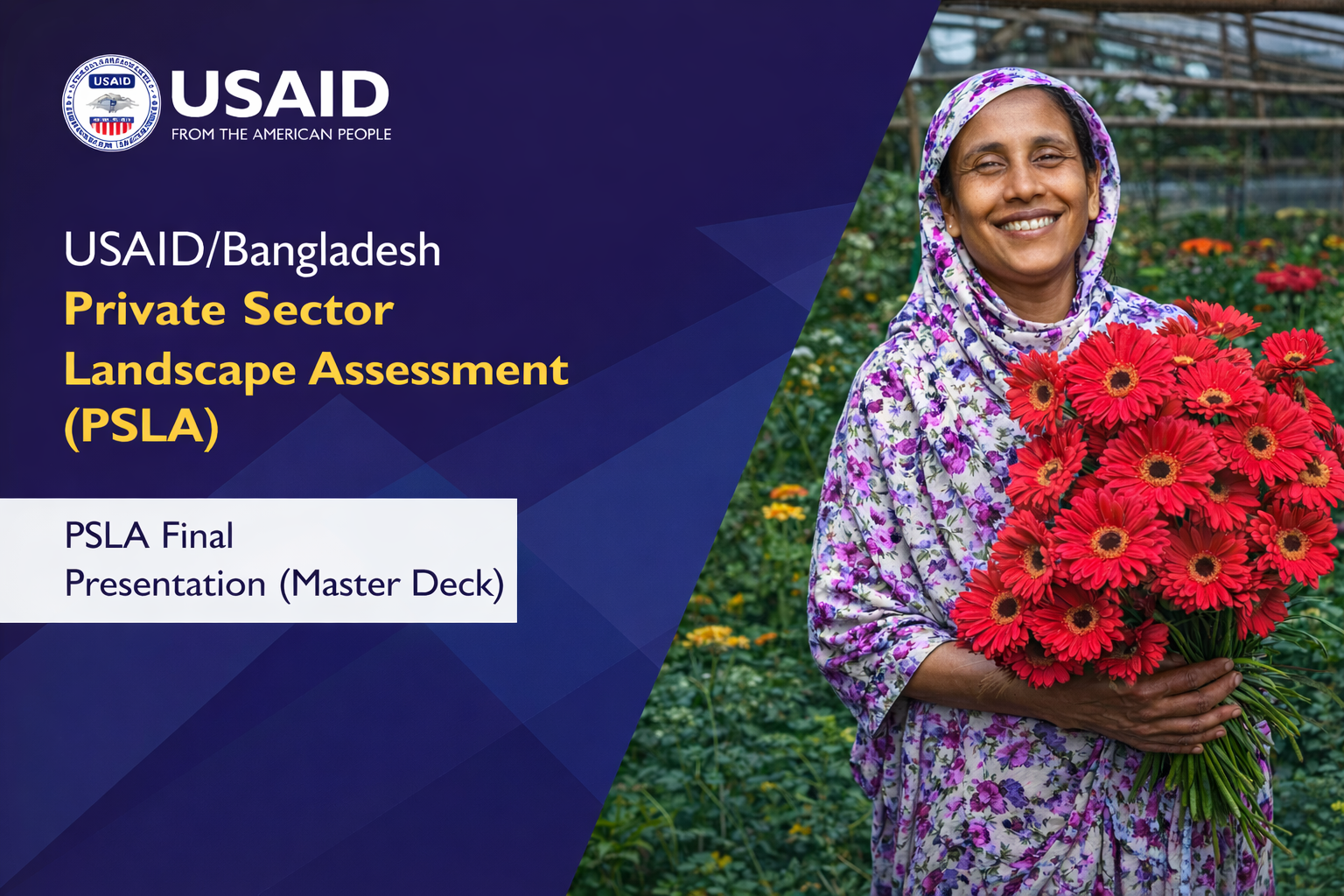
Quay Asia completed a comprehensive private sector landscaping analysis for USAID Bangladesh, conducting 93 key informant interviews with business leaders, industry associations, government officials, and development practitioners. The study sought to map the private sector landscape, identify shared value opportunities, and recommend co-creation pathways that align commercial interests with development outcomes.
Mapping the Private Sector Landscape
Bangladesh's private sector has undergone remarkable transformation over the past two decades. Beyond the dominant readymade garments industry, dynamic sectors including pharmaceuticals, ICT, agribusiness, light engineering, and financial services have emerged as significant contributors to economic growth and employment.
Our landscaping analysis mapped over 200 companies across USAID priority sectors, assessing their scale, growth trajectory, workforce demographics, sustainability practices, and potential alignment with development objectives. The findings revealed a private sector that is more diverse, innovative, and globally connected than commonly perceived.
The Case for Co-Creation
Traditional development programming has often treated the private sector as either a beneficiary or a donor - rarely as an equal partner in programme design and delivery. Our research found that this approach has limited the scale and sustainability of development interventions.
Co-creation - where development agencies and private companies jointly identify problems, design solutions, and share risks and resources - offers a more promising model. Companies that participated in co-creation processes reported higher levels of engagement, greater ownership of outcomes, and more sustainable business model innovations.
Shared Value Across Priority Sectors
The study identified concrete shared value opportunities across several USAID priority areas. In agriculture, companies investing in smallholder supply chains can simultaneously improve product quality, ensure traceability, and lift farmer incomes. In health, pharmaceutical firms expanding rural distribution networks can reach underserved populations whilst growing their customer base.
In workforce development, the ICT sector's demand for skilled talent aligns directly with youth employment objectives. Companies are willing to co-invest in training programmes that produce work-ready graduates, particularly in digital skills, data analytics, and customer service - areas where Bangladesh has significant export potential.
Barriers to Partnership
Despite the opportunities, our interviews revealed persistent barriers to private sector-development partnerships. Companies cited bureaucratic procurement processes, misaligned timelines, unrealistic reporting requirements, and a lack of understanding of commercial realities as key frustrations. Development agencies, for their part, noted concerns about reputational risk, difficulty measuring development impact in commercial partnerships, and the challenge of ensuring additionality.
Bridging these gaps requires new partnership modalities - including challenge funds, results-based financing, and technical assistance facilities - that reduce transaction costs and align incentives for both parties.
Recommendations for USAID
Our analysis recommended that USAID Bangladesh adopt a more systematic approach to private sector engagement, including establishing a dedicated private sector liaison function, developing standardised partnership frameworks, and creating a pipeline of co-creation opportunities informed by regular market scanning. The study also recommended investing in building the capacity of local intermediary organisations that can facilitate ongoing dialogue between the development and business communities.